
Rensselaer County Criminal Court Cases
Felony cases in Rensselaer County may proceed in County Court or Supreme Court. County Court also hears appeals from local courts. Troy City Court, Rensselaer City Court, and town or village justice courts handle misdemeanors, violations, arraignments, and preliminary felony proceedings within their limits. An indicted felony that starts with an arraignment in a local court can therefore appear later under a County Court docket. The place of the alleged event and the issuing court are strong clues when names alone produce a poor match.
The clerk of the court where the matter was filed is the authoritative custodian. For Supreme and County Court records, the County Clerk Records Room at 105 Third Street, Troy, handles older or non-online files and certifications. The criminal clerk at the Rensselaer County Courthouse can help confirm which counter has a requested file. Local court records remain with the applicable city, town, or village clerk.
Rensselaer County Older Court Files
A blank online search does not end the inquiry. Older local matters may fall outside current WebCriminal coverage, and town or village reporting can be uneven. Start with the official New York court locator, match the event location to the likely court, then ask that clerk to search by full name, approximate filing date, and docket number if known. Supreme and County Court requests can be directed to the Records Room at 105 Third Street, open weekdays from 8:30 a.m. to 4 p.m., at 518-270-4080.
County Clerk Records Room
105 Third Street
Troy, NY 12180
518-270-4080
Monday-Friday, 8:30 a.m.-4 p.m.
Supreme and County Court
80 Second Street
Troy, NY 12180
518-285-5025
Monday-Friday, 9 a.m.-5 p.m.
Call first to learn whether the criminal clerk or Records Room handles the exact copy or certification. Ask about identification, copy format, certification, and current payment methods before visiting. That small step avoids a trip between two Troy counters.
Searching Rensselaer County Case Records
WebCriminal provides free current case information for covered New York criminal courts. It works as a locator, not a complete case file or fingerprint-confirmed history. Search by defendant or case number, note the court and docket, and then verify key details with the clerk. A five-part search keeps the online summary tied to the original record.
- Identify the city, town, or village where the case began and locate the court that serves it.
- Open WebCriminal and choose defendant name or case-number mode.
- Enter exact known details and use the county or court filter when it is available.
- Record the court, docket number, current status, and next appearance shown.
- Contact that clerk for filed papers, plain copies, or a certified disposition.
| Field Label | Type | Required | Notes |
|---|---|---|---|
| Search by Defendant | Tab | One mode | Name-based current-case search |
| Search by Case Number | Tab | One mode | Use the exact docket identifier |
| Last Name | Text | Usually | Use exact spelling |
| First Name | Text | Live validation | Narrows common-name results |
| County/Court | Filter | No | Available courts and coverage vary |
| Search / Clear | Buttons | Search only | Runs or resets the query |
WebCriminal may show an appearance and status without offering the underlying papers. Treat the result as an index to the correct Rensselaer County clerk. The official CHRS questions and answers explain the statewide summary's scope, while the mail CHRS application supplies its separate paper route. When a name search fails, try the docket identifier and ask the local clerk about spelling, aliases, older coverage, or sealing. Do not infer that a missing online entry means no case existed.
Rensselaer County Court Routing
Rensselaer County court names can mislead a searcher. The City of Rensselaer has its own City Court, which is distinct from Rensselaer County Court in Troy. Troy City Court also keeps its own misdemeanor and preliminary records. Supreme and County Court handle the county's felony-level work, while local justice courts keep matters arising within their towns and villages. The official Third Judicial District county directory helps identify those separate clerks. A search for only the county name may miss the correct local docket.
Offense class helps narrow the route, but it does not replace the filed record. New York felonies run from Class A through E under Penal Law §70.00, and misdemeanor jail terms are addressed by Penal Law §70.15. The offense statute can alter those general rules. More important for a record search, the arrest label is preliminary. The prosecutor may reduce, replace, or decline it, so the filed accusatory instrument and final disposition control the case classification.
Inside a Rensselaer County Case File
A Rensselaer County case file tracks what the court received and did. It is more detailed than a booking entry and narrower than a fingerprint-linked DCJS rap sheet. Public views may show basic docket fields, while the clerk's file can contain the complaint or indictment, motion papers, plea entries, orders, and judgment. Some filed documents may not be downloadable from WebCriminal.
| Case Number and Court | Identifies the docket and the clerk responsible for it. |
|---|---|
| Charging Document | Shows the complaint, information, or indictment actually filed. |
| Docket Entries | Lists filings, appearances, motions, and court actions in date order. |
| Hearing Dates | May state the next date, time, appearance type, and assigned judge. |
| Disposition and Judgment | States whether a charge ended in conviction, dismissal, acquittal, or another result. |
| Sentence and Conditions | Records the court-imposed consequence after a conviction. |
Protected identifiers, victim details, sealed matters, and confidential filings do not belong in the public view. A missing field should be checked with the clerk rather than guessed from another record.
Rensselaer County Certified Dispositions
A Certificate of Disposition is the court-sealed answer to a case's outcome. It states the charge, conviction when applicable, conviction date, sentence, and the court's certification. That makes it more reliable for resolving a vague name-search summary or a charge that changed after arrest. Request it from the court that disposed of the case, not from the jail, sheriff, prosecutor, or DCJS.
The New York courts certificate guidance explains the document and request route. The source also illustrates the court record readers should seek when an outcome matters.
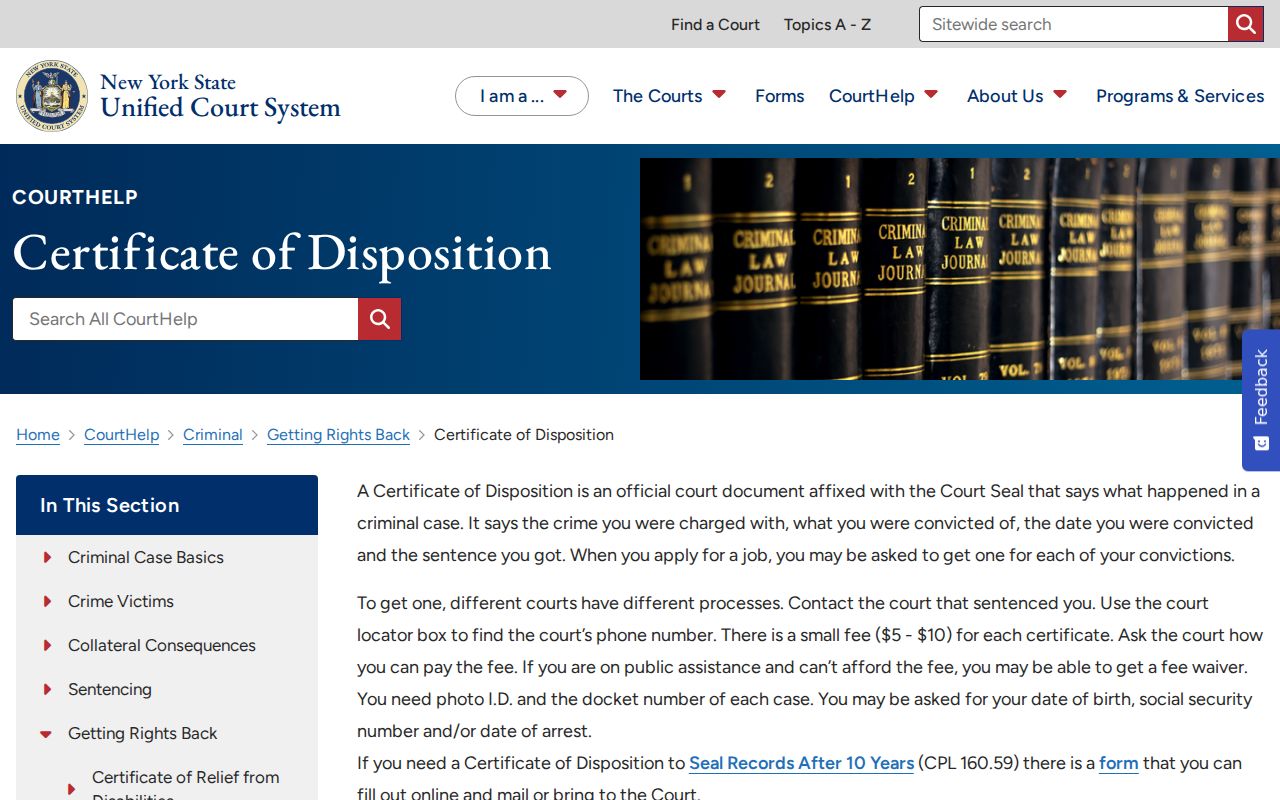
Keep the certified copy with any sealing order or correction request. It can show the exact final charge when an arrest record still reflects the initial allegation.
How a Criminal Case Moves
A Rensselaer County criminal case begins when a prosecutor files an accusatory instrument, which is the formal paper setting out charges. Arraignment is the first court appearance where the charge, counsel, and release issues are addressed. Pretrial work may include conferences, motions, discovery disputes, and plea talks. The matter then ends through a plea, trial, dismissal, or other disposition. Sentencing follows a conviction.
Case flow: Charges Filed › Arraignment › Pretrial › Plea or Trial › Disposition › Sentencing
The record changes at each point. The District Attorney may decline, reduce, or replace an arrest charge before the docket ends. That is why a filed charge and disposition should be read together.
Rensselaer County Charging Changes
The Rensselaer County District Attorney prosecutes felony and misdemeanor matters and assigns prosecutors to local courts. Its filing decision can make the docket differ from the police report. A complaint may lead to an information, an indictment, a reduced count, or no prosecution. An indictment is a grand jury accusation used for felony prosecution; it is not the same as a conviction. The Sheriff's arrest file and the Correctional Facility booking file remain separate from this court record, even when all three describe the same event.
- Accusatory instrument
- The complaint, information, or indictment that formally charges an offense.
- Arraignment
- The first court proceeding addressing the charge, counsel, and release conditions.
- Disposition
- The final result of a charge or case.
- Docket
- The dated court record of filings and events.
For questions about what was ultimately prosecuted, use the court file. A police narrative explains the alleged event, but the court docket shows the legal case that followed.
Case Record Access & Restrictions
Filed Rensselaer County court records are requested from the court or County Clerk, not through the county's general FOIL form. New York Freedom of Information Law applies to agency records, but court records follow judiciary access rules. Online views can omit full birth data, Social Security numbers, victim identifiers, and confidential filings. Juvenile and youthful-offender matters also have strict limits.
Sealed cases are not ordinary public records. CPL 160.50 covers sealing after specified favorable outcomes, while CPL 160.59 allows eligible people to seek ten-year conviction sealing. If a case should be sealed but appears publicly, obtain the disposition and sealing order, ask the originating clerk to confirm its system, and use DCJS Personal Record Review for correction of one's own repository record.
OCA's paid CHRS search is a separate statewide exact-name and date-of-birth summary. It costs $95, excludes sealed matters, and can have historical local-court limits. It does not replace the local docket or a certified disposition.
New York's Clean Slate implementation can also change public visibility as eligible cases are processed. OCA has through November 16, 2027 to complete the statewide system. Check the current court status rather than assuming that every eligible Rensselaer County case has already been sealed.
Federal Cases Near Rensselaer County
Federal criminal matters from Rensselaer County belong to the Northern District of New York, not the county courts. The official federal docket channel is PACER, which requires registration and may charge under the judiciary fee schedule. A county clerk cannot certify a federal judgment, and WebCriminal does not serve as the federal docket.
The PACER source provides the separate federal route used when a name or event does not belong in a New York state-court search.
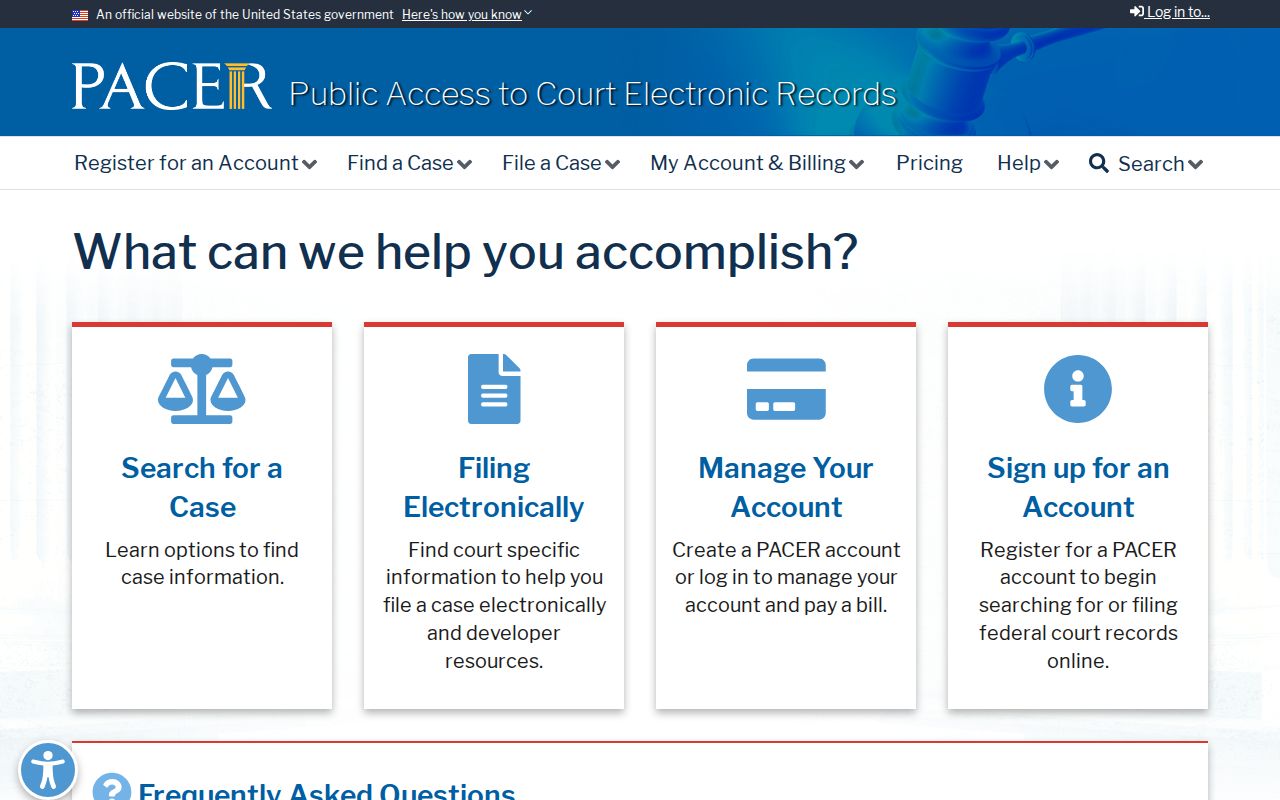
Confirm filed documents and case status with the federal clerk when the docket is federal. County and state court channels cannot supply that original record.